Showing posts with label pavements. Show all posts
1.6.15
I never knew sandwich boards could be so emotional
It's Monday. I think Aha, the sandwich board will be outside the Co-op! I can photograph an example of graphic material and textual language constructing my environment!
After fifteen minutes, I've seen so many, and become so aware of how my walking needs to change around them - been submerged so deep in their rich textures of time, mood, voice and my recollections - that I've begun to cross the road to avoid them, to take the quiet way home and rest.
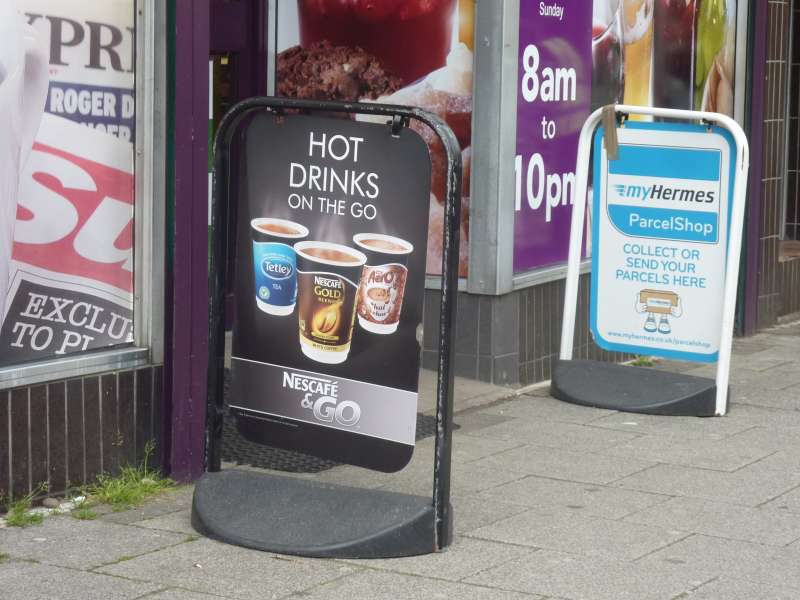
These propped up staggered sandwich board advertisements are everywhere.
Why didn't I notice so many of them before? I feel a little ashamed. I've walked past these obvious plastic / metal / wood / blackboard constructions, made in a variety of shapes and heights using a variety of fastenings - some with articulated movements, some with creaky hinges, some flapping at me waving, and some that make me walk in a frankly bizarre side-stepping manner just short of the gutter. And how many did I notice before?!
Well, I notice now, and this is what I'm thinking.
They mark time, these visual metronomes. At 10 am on a Monday morning I knew in advance these signs would be on the streets. I had them in my sense of the hour. Now I walk along with them, I feel they are like a dance of time, creating the routines of time, day, night, keeping their quiet rhythm with commerce, appearing with the morning and retreating in the evening. But there's a sidestep in the routines, one day each week, and bank holidays, take a skip for retail closure.
But day-by-day, their place shifts and moves my pavement territory. While their words do not explain events here, on the pavement, they show me some other location, nearby: they tell me of elsewhere but carve out place now, take my space, push me into roads, send me into body weaves with other passers-by, force me to side-step, swerve, walk in angular curves.
As I walk, I watch their words which stay the same and change. Here is a street of poetry and song; here is a polyphony, this Song of the sandwich board - a street for many voices. The words can change daily, weekly, Special offer, New this Week, Open Now, Happy Hippies, or the voices look to stay for longer, be with me through the summer, were there in my past, perhaps a low steady beat to my season or a year - play here find out more book your eye test think food.
These words are my street collage of history, memory, prediction, expectation. Mapped emotionally in a geographic space I would expect to see a strange patterning of remembering and desire - ice cream on a hot day; comfort and consolation - coffee on the go; anticipation and thrill - a lottery ticket that just might win; duty and responsibility - my obligations to the cat, the dog, the food, the house. These pools of text, not in themselves emotional, but leading me along a street of states I might remember or for comfort want to repeat, again and again, send flowers hot drinks open books open.
26.5.15
Pavement power
In this local town within Milton Keynes, we have a town walk.
I am not convinced, by the way, that the town walk has been installed for the benefit of tourists. I think it is here, like the community artist, to engage the residents with our own town; to help develop a sense of history, and engender shared values about preservation of heritage.
I wonder if, in its origins, planners and developers felt such a walk was needed when a highly mobile population became likely. We have an ethnic population of the town, largely Pakistani, who may come and go. Maybe the longer-term town residents felt it was right, under such circumstances, that the existing population communicated to a transitory population the message 'You may pass through, but you are entering a town with a history of its own. Look - we wrote our history on the pavement where you stand.'
And indeed, the town walk does exert this curious sense of cohesion and obligation on me. I make my family walk along it once a year at a town event - it feels something like our responsibility and duty, performing our act of ordinary citizenship by this group acquiescence; this communal 'beating the bounds'.
In that way, the town walk may be working its sly and pretty pavement text-and-graphic power upon us citizens. (Probably not for the recently arrived populations, who may wonder what it's for.)
Anyway, we have a town walk. A 2.5 Km walk, guided by pavement markers taking us past buildings of historical or architectural note.
It starts (and ends) in a Victorian square, appropriately the traditional place of public assembly, memory of group endeavour, and a place of expectation of continuity. Here is the War Memorial, place where the town Christmas Tree is installed, and site of an annual brass band performance.
These are the markers which guide us and which do not carry text. When we reach a marker with text, we know we have reached a point of significance.
Here is significance through text: a marker of territory. It tells us where we are - it fixes us here, now, on this spot. It makes me stop my progress. Dutifully, obediently, I turn my head to look up, even though I'm very familiar with the tower the pavement text is referring to.
But if we are following the town walk, we are not to pass by! Indeed, this next pavement marker directly instructs me to LOOK OUT FOR...
By following the town walk faithfully, I could argue that it is an act almost of submission. I am agreeing to be a citizen of this town; I am choosing to accord to a viewpoint in which another has described my history and determined our territory. The text on the pavement tells me which building is interesting, and I am somehow bound to agree.
Departing from the town walk starts to feel almost like an act of rebellion.
So I'm concluding that this structured route is indeed about a 'town belonging'. The text is a significant territorial marker that reinforces my citizenship; it demands agreements and unities.
When I walk this route, for the duration of my progress I put aside all other more contradictory or subjective impulses - my need to tell other stories or argue which building is nicer or which site is older. As I marshal the family to complete this annual town walk tour, the only subversion acceptable is back-chat about the weather.
(And thank goodness we're only talking about the role of signage in the local town walk, and not our submission to the territorial-based ideology of the nation state!)
I am not convinced, by the way, that the town walk has been installed for the benefit of tourists. I think it is here, like the community artist, to engage the residents with our own town; to help develop a sense of history, and engender shared values about preservation of heritage.
I wonder if, in its origins, planners and developers felt such a walk was needed when a highly mobile population became likely. We have an ethnic population of the town, largely Pakistani, who may come and go. Maybe the longer-term town residents felt it was right, under such circumstances, that the existing population communicated to a transitory population the message 'You may pass through, but you are entering a town with a history of its own. Look - we wrote our history on the pavement where you stand.'
And indeed, the town walk does exert this curious sense of cohesion and obligation on me. I make my family walk along it once a year at a town event - it feels something like our responsibility and duty, performing our act of ordinary citizenship by this group acquiescence; this communal 'beating the bounds'.
In that way, the town walk may be working its sly and pretty pavement text-and-graphic power upon us citizens. (Probably not for the recently arrived populations, who may wonder what it's for.)
Anyway, we have a town walk. A 2.5 Km walk, guided by pavement markers taking us past buildings of historical or architectural note.
It starts (and ends) in a Victorian square, appropriately the traditional place of public assembly, memory of group endeavour, and a place of expectation of continuity. Here is the War Memorial, place where the town Christmas Tree is installed, and site of an annual brass band performance.
These are the markers which guide us and which do not carry text. When we reach a marker with text, we know we have reached a point of significance.
Here is significance through text: a marker of territory. It tells us where we are - it fixes us here, now, on this spot. It makes me stop my progress. Dutifully, obediently, I turn my head to look up, even though I'm very familiar with the tower the pavement text is referring to.
But if we are following the town walk, we are not to pass by! Indeed, this next pavement marker directly instructs me to LOOK OUT FOR...
By following the town walk faithfully, I could argue that it is an act almost of submission. I am agreeing to be a citizen of this town; I am choosing to accord to a viewpoint in which another has described my history and determined our territory. The text on the pavement tells me which building is interesting, and I am somehow bound to agree.
Departing from the town walk starts to feel almost like an act of rebellion.
So I'm concluding that this structured route is indeed about a 'town belonging'. The text is a significant territorial marker that reinforces my citizenship; it demands agreements and unities.
When I walk this route, for the duration of my progress I put aside all other more contradictory or subjective impulses - my need to tell other stories or argue which building is nicer or which site is older. As I marshal the family to complete this annual town walk tour, the only subversion acceptable is back-chat about the weather.
(And thank goodness we're only talking about the role of signage in the local town walk, and not our submission to the territorial-based ideology of the nation state!)
14.5.15
How temporary is temporary?
Examples of how the town changes its signage in any 24-hour period. These signs came up one day along long stretches of back alleyways in the town.
They're public signage familiar from our driving system and identical to all roadworks up and down the UK.
Of course the road isn't closed when I take these photographs and there's little evidence of work.
Unlike the Road Closed sign, confusingly against a road which looks open (above), the sign (below) is quite accurate in the information it gives against the view I can see. This driver's sign suggests the road narrows on the left within a few yards, and indeed it does.
But the signs are of the anonymous sort. Who put them there? Could these signs have been put here by private contractors about the work on the road?
Although these signs don't tell you, I know they're in preparation for the water board to work on the underground pipes. These signs are part of a two-stage process: the staff first deposit the signs in the afternoon, then the water workers arrive about 9pm to move the sign to the centre of the road while they work on the pipes overnight.
Probably I have some local contextual knowledge about this; I know how these signs are going to move. I gained it generally from watching how people work and how they move signage around to take control of the space, in this case while they need to dig holes in the ground. And the other night the water pressure in my tap went down. The local people around me have probably worked this all out as well. So we'll mix our local understanding with our awareness of what consequence these anonymous, identical signs hold for drivers and pedestrians.
So who are these signs for? Everyone or just a few people? Drivers, certainly. By these signs they're encouraged to avoid potential problems and find other routes around the town. But also the very specific audience of residents who have garages and access points along these roads where the entrance is marked by these signs. These signs say, Will you want to move your car in and out your garage after midnight and overnight? You can't. Park on the street.
Subscribe to:
Posts (Atom)


