Showing posts with label public authority. Show all posts

8.6.15

Who's watching?

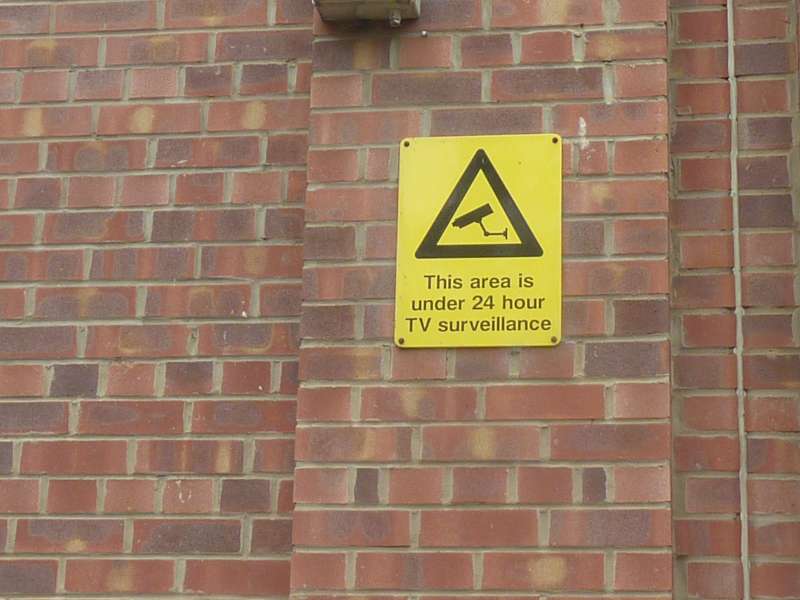
Here is the sign of the camera eye, articulated on its jointed arm.


CCTV in operation. That is a strange phrase to me. In operation implies the unstoppable force of powerful machinery; the authority of a business-like procedure; an incision made to investigate the corporeal by the rational surgeon. Unemotional, every one. Perhaps the phrase suits the icon of the blanked out, indiscriminate, unfeeling, unblinking camera eye, because the phrase in operation appears in these signs routinely.


With this notice, it's as if the installer thinks, 'in operation' is not powerful enough. Any passer-by is warned - if they'd like to creep back to that site to DUMP RUBBISH at 3am, then unrelenting 24hr recording will be ongoing at that time too.


Surveillance. This word is interesting, because it all depends on your point of view, doesn't it? I might 'keep an eye' on a family member's comings and goings, and I might consider that my dutiful role of care. But if my family member doesn't welcome such scrutiny, they might call it surveillance.

When used on a sign with CCTV, perhaps this word, surveillance, already has within it the possibility that the watchfulness is similarly unwelcome. Perhaps the installer of the sign would like me, passer-by, to construct for myself the identity that 'the sign obviously doesn't reference me, because I'm not doing anything that needs watching'. Perhaps the installer would like only would-be criminals to be alarmed! The word seems generally to fit with the popular theory that crime caught on CCTV is easier to detect, therefore would-be criminals are less likely to commit crimes.


I pass these signs routinely, and I look back with my own jaundiced eye.

Surveillance camera systems are familiar to me in public places. Installed by private and public bodies and by charitable, community or voluntary bodies that span both private and public interests, they're in shopping centres, sports venues, and schools; they monitor transport, keep an eye on places where medicines are stored, and point along streets to vehicles and people.

They create debates about civil liberties, the Big Brother state, an Orwellian future. We can argue whether there is cause-and-effect with crime detection and CCTV.

But, except for the last sign there, none of these signs - cautioning the use of CCTV - in themselves fully comply with the Data Protection Act (1988).

The Home Office Surveillance Camera Code of Practice (June 2013) reminds the installers that they are under a legal obligation to alert the public through signage to the use of cameras, to publish a contact for who's watching, and to explain why the system is needed.

These notices should tell me the identity of the person or organisation responsible for the camera, their contact details, and tell me, passer by, why the camera is there - what, in the view of the installer, is the purpose of the camera system? What's more, The Data Protection Act requires most data controllers, whether they are an organisation or an individual, to register with the Information Commissioner's Office that they are monitoring and processing visual information by camera.

So I have recourse to law if I feel these requirements are breached.

But to whom would I address my questions on the ground, in this physically monitored space? Someone who never put the sign there but who perhaps feels protected by the security it promise? Would they look back at me, and wonder what could be my motive for undermining what must surely be a public good - the CCTV at the school gates, at the road junction, the back lane, the quiet corners?

These signs indeed send out messages about the way we live. They say, at this point, on the behalf of the hidden watchers, surveillance is necessary: you live amongst criminals, opportunists with bad intent, addicts, people who need watching. These signs say, You down there, who might be up to No Good. We're watching you, just to make sure. Perhaps they even construct part of me as a would-be criminal. I start to imagine myself creeping the back lanes with my bag of rubbish.

But then, I wonder if the camera is connected at all? Do I stare at a dummy camera, sited blind and unmoving on the wall? Who knows? We only have the sign to say.

18.5.15

The Conscience Inside my Head meets the Judgements of the Outside World

We have many NO PARKING signs around the town.


People paint these signs - or put up ready-made signs - on garage doors at their properties, or by public spaces adjacent to their property boundaries, or where doors and gates are associated with business premises.


Basically, I think of these NO PARKING signs as meaning the person putting up the sign wants to claim, temporarily and arbitrarily, the public space by the sign. To claim a priority over this space, they use the short, prohibitive language of authorities who have legal powers: NO PARKING. (Even though the resident's sign simply means, We want this space whenever we like!)

These signs are clearly aimed at drivers rather than pedestrians, and they face outward to public access.

I interpret these signs to refer to the physical space in front of the gates or, as in this next example, the space in front of the sign, and not a declaration that parking is not allowed on the inside of the door, gate, or structure, where their own vehicle is kept. (That would be ironic, yes?!)


I see these NO PARKING signs all around this car-dense town. I wonder if they're telling me about existing points of conflict between vehicle traffic - corners, turnings, narrow roads, junctions of private land and public road, and so on.

(Here the No Parking sign is enforced by the threat of a bit of metal.)


(The threat of clamping is losing its power, I think, thanks to legal restrictions on clamping companies.)

I can see how the signs appear in a range of materials, media, colours, letter organisations and sizes, and on a range of surfaces (but I've not yet seen one painted on the ground). Sometimes these signs are alone or with other signs; sometimes they explain the prohibition (as if the word NO needs a reason); sometimes politeness words are added. It's quite a rich mix.


(Classy - engraved and painted in gold letters on grey slate, and with the added polite word please!)

The hand-painted signs I see are often in capital letters. And I wonder if the person, in the act of painting, thinks, 'the bigger I paint this, the more it will show I mean it and I will follow it up with a hammer!'


Perhaps the writer hopes the super-large paint gives the word not simply greater visibility but greater authority, maybe as if the owner was there to wave their arms, and shout 'My patch! Clear off!'

(The strategy of paint it large and write it twice clearly doesn't work.)

People place shop-bought metal signs too. These signs might contain red (danger! authority!); have a circle and bar (standard sign meaning 'NO'); and the accompanying text might be in lower case.


But how do I, as a driver, read these signs? I'm just driving around, desperate for a parking space!

This is probably the order of my thinking.

1. Is there a Council logo?
If there isn't, then I might risk parking the car, perhaps for a short time. Like below. These NO PARKING signs are not 'official'. I know they are 'unofficial' - i.e. put up by residents and people working at businesses - because these signs do not bear the Council logo. Ha!

(Should I risk it? Signs not from the Local Council!)

The Council logo comes with this strange power: it carries the inference that their instruction, NO PARKING, can be backed up with 'official sanction'.

Might they bring these sanctions to me at any future time - long after I've moved the car from the NO PARKING site? What if there are cameras? I imagine the Council use CCTV to aggressively outline, monitor, and sanction their spaces. They would either very smartly have a foot-patrolling traffic warden on me, or maybe I'd receive a fine through the post? Either way I'd face a financial punishment of £60. I couldn't claim ignorance, disability, noble cause or hardship to wriggle out of it. I already feel a bit disreputable just thinking about trying.

Then again ... I do not know whether events would unfold like this. Could I get away with my 'illegal' activity? But I've had the experience of being fined for overstaying a parking limit by the Council. (I could have spent my sixty pounds on something better.)

Past experience guides future wisdom, so affects my present behaviour. My judgement says, 'Never park in places that have the Council logo!'

(Should I risk it here instead? Signs not from the Local Council!)

But look, these are not Council-marked spaces! They're from locals protecting their garage access. And I don't believe these (literally) half-hearted attempts to control this space with a broken threat about clamped.


But what am I learning so far about these urban NO PARKING signs?

I'm already using these simple two words as a starting point to weigh up the risks of legal enforcement and financial punishment, even though these signs largely mention no such things.

2. What lines are on the road?
Double yellow lines mean NO PARKING. If a shop-bought NO PARKING sign combines with double yellow lines, what is that telling me? That the owner knows people ignore the traffic law here, so they're reminding us of it? Will it mean the controller of this door has the right to ring up a traffic warden, have them pop over, and slam! Another £60 fine!

What about the place below? Could I park? Here are two signs on brick, not on the garage door. I wonder if brick gives the signs the reference point to the road, rather than to a measurable space in front of the garage door.


But look. They win. I'm not parking here. Too risky with those double yellows.

What of this next place? No double yellow lines here! The yellow perils end with a bar, to the right-hand side of the precious parking space.


Would you park? A low risk of a fine? Only for a short time? 

But I'm now checking the immediate context as well as the sign. This tells me that signs work with and within their surroundings: I need more clues than just the sign if I'm to take away the information on which I make my judgement.

And now of course I now make Consideration Number 3.

3. Safety.
As drivers, we're brought up to the idea that road signage helps maintain free-flow of traffic and ensures public safety - we are, after all, in charge of a vehicle that can be deadly. I scan along the road ahead and behind to look for how the road shapes; I'm assessing the likely movement of other vehicles.

If I park here, impede the traffic way, force another driver to change speed and direction, and they have an accident - horror! what if they are injured? - then can I retrospectively defend my judgement when I contravened a NO PARKING sign? What's my insurance position if another driver hits my car, parked in front of two NO PARKING signs? And what if I am sat in my car and am injured too?

Now my parking decision, which started with one sign, is all mixed up with my speculation of the future, my fear that I'll be despised because my inconsiderate actions hurt another driver, I am in hospital myself, I have no car to park because someone else drove into it, and my insurance premiums will rise.

I need consideration Number 4.

4. Consideration.
I guess these next NO PARKING signs trade on this. While the sign on the right is the standard variety I'd expect to buy at the home-and-garden centre, the sign on the left seems to recognise that this anonymous, industrially-stamped metal sign with its generic NO circle, well, it has no real force of law unless backed up with yellow lines. (There aren't any.)

Hence the owner of this gate (and would-be controller of the public space) appeals to my sense of neighbourliness and ethical behaviour by explaining why they want to control access.


Now who is unkind, uncaring, and cruel enough to park here?

What I've found out about these signs is how little they say in words - two words in some cases - and those are prohibitive rather than information-giving. But how much is going on in my head! How much culture, contextual knowledge and personal experience I'm bringing to the sign! It's a bit scary, even to me.

My judgement about where to park the car now includes thoughts such as - Should I park far away, walk, and take exercise? Should I start a pressure group for Resident Permit Parking? Should I even own a car, if parking is so much trouble? My culture, ethics, sense of morality, safety, responsibilities of car ownership, thoughts about insurance, fears about the power of the local authorities, my willingness to engage in hierarchies of deference or my impulse to protest and be defiant, my stand about the right of public spaces not to be claimed by private hands, my risk and hazard perceptions, my self-identity, friendliness (or otherwise) with the neighbours, my experiences of the past, my judgements about the future, my needs of the now, and the practical considerations (driving round back streets looking for a parking space on an empty fuel tank) sometimes leads me to do what I said to myself I would never do, never, ever.


Park in front of NO PARKING signs with Council logo. But aha! Precise local knowledge tells me I can get away with parking in front of the left door for 20 minutes after 6pm. But not in front of the right-hand door. (Never the right-hand door.)

So what did I learn? These signs - which state unambiguous prohibitions and attempt to control my behaviour at the moment I read them - only ever impact on my thinking; they do not ultimately determine my behaviour. Over a period of time, they may get me to think in particular habitual ways and so, in some way, regulate, or organise my behaviour.

In this way, it could be argued that signage could be used as one point to explore a view of myself in the world meeting the world telling me what to do. (That would create a piece of text for a psychological fest or some phenomethodological fun!)

But these signs also have suggested to me more than my own psychological analysis.

They suggest ideas about authorship, authorities, declarations, needs, wants, and motive; I now wonder about how people use signs to negotiate as if by proxy when they themselves are not there; I have a view of how drivers and signers behave and interact in space and place; time seems to be an important part of how I interpret signs - I might be able to reinterpret their message at different times of the day, or they may carry a weight into the future, or suggest a history of the past; I realise I need to study context and place alongside the actual sign to extract meanings from it; I might need to assess a variety of information in graphic form through this world of communication by colour, shape, size, composition, form; and then I bring to any interpretation a huge amount of my own cultural experience and local knowledge - before I even begin with how all these assessments and judgements feed into my actual driving behaviour.

All thanks to the fact I couldn't find a parking space.


15.5.15

Because we don't have a Town Crier

Here are signs that can tell me much about politics, power relations, responsibilities, legal duties of many parties, the administrative structures that form our democracy, and something about the way time and intention is marked in an urban setting.

So I'll try and keep this post short.

Here are notices at the meeting point between the Local Council and the public.

These are recognisable notices. They have a standard Council logo, use a sans serif print style, have justified text, uniform paper size, and are uniformly fixed to objects by cable ties. They tell us about impending events of public consequence, such as planning applications, licensing laws, traffic restrictions and so on. The notices are all written solely in English and can contain any mix of text, graphics, and handwriting.


Locally, we see multiple copies of the same signs attached to streetlights or other objects under the management of the Local Council. These signs are frequently tied, just above my head height, to objects along routes where there are many pedestrians, or where pedestrians are likely to physically turn, as at a road crossing or other junction. They are clustered in the area that we could broadly say is the town centre, or the main access routes to and from the centre.


I think we citizens of England and Wales are quite keen on these notices. Perhaps we feel these signs are an important part of communication between the Local Councils and the ordinary people in the streets affected by the decisions of our elected representatives.

Of course it could be argued that any power is really retained by the Council: these notices are in a small typeface and placed locally for a limited time so the authorities can defend themselves against an unpopular decision by declaring 'we told you the way to object'.

But it can also be argued that these signs tell us a part of our democratic structure is working. The people putting up these signs declare what the proposal is, which department they are issued from, information on the means of objections, information about appeals, legal status, and contact details.


For my part, I don't feel these signs show power flowing from top to bottom. Rather, these notices have the status that if we want to complain about anything, or have a say about an  application, then here are the details of where, and when, we can do that.

Indeed, even reading a part of these notices is somehow democratising - regardless of who we are, we have access via our street setting to the meeting rooms of local decision-makers.


We're so keen on public engagement, we even have a website for Public Notices for England and Wales: www.publicnotices.co.uk

Here you can look up the notices in an online world where you may not physically be able to read them on the street. (I guess there is a whole discipline about Language Landscapes Online.)


I'm not saying there is not a degree of cynicism about planning or licencing procedures, but these plastic-covered notices, securely fastened, routinely placed, and promptly removed, are perhaps valued, even if the number of those actually following up the invitation of practical engagement in local planning remains small.

14.5.15

How temporary is temporary?


Examples of how the town changes its signage in any 24-hour period. These signs came up one day along long stretches of back alleyways in the town.

They're public signage familiar from our driving system and identical to all roadworks up and down the UK.


Of course the road isn't closed when I take these photographs and there's little evidence of work. 


Unlike the Road Closed sign, confusingly against a road which looks open (above), the sign (below) is quite accurate in the information it gives against the view I can see. This driver's sign suggests the road narrows on the left within a few yards, and indeed it does.


But the signs are of the anonymous sort. Who put them there? Could these signs have been put here by private contractors about the work on the road?

Although these signs don't tell you, I know they're in preparation for the water board to work on the underground pipes. These signs are part of a two-stage process: the staff first deposit the signs in the afternoon, then the water workers arrive about 9pm to move the sign to the centre of the road while they work on the pipes overnight.


Probably I have some local contextual knowledge about this; I know how these signs are going to move. I gained it generally from watching how people work and how they move signage around to take control of the space, in this case while they need to dig holes in the ground. And the other night the water pressure in my tap went down. The local people around me have probably worked this all out as well. So we'll mix our local understanding with our awareness of what consequence these anonymous, identical signs hold for drivers and pedestrians.


So who are these signs for? Everyone or just a few people? Drivers, certainly. By these signs they're encouraged to avoid potential problems and find other routes around the town. But also the very specific audience of residents who have garages and access points along these roads where the entrance is marked by these signs. These signs say, Will you want to move your car in and out your garage after midnight and overnight? You can't. Park on the street.

3.5.15

Caution

This is what we do to streetlights in our town.


They look like something horrible happened to them. Maybe they fell foul of a criminal organisation, who chopped them up, bagged their body parts, and dumped them in a public place as a warning to other streetlights.


I find several points to make about these urban stumps.

1. I first had to work it out. These were once streetlights. I only did so thanks to the proximity of the new lights next to them.

2. I realise I have no idea how many weeks discarded streetlights stay like this before they're removed completely from my townscape. (I'd guess that if they were sited on a main tourist route, they'd be gone in 24 hours. Down the back lanes of a small town, might they be here for weeks?)

3. The colour of the bagging tape is yellow, not red. I'm tentatively guessing a yellow colour (like a traffic-light system) is intended to convey hazard rather than outright danger. (Now I'm reassured. I had feared live cables were waiting to electrocute me - and anyone else who associates too freely with streetlights.) I wonder if yellow shines better in the dark in your reversing car window?

4. When I pay more attention to the text, I realise it's like an indication of text. Upside down, partially obscured, these words are almost intended not to be read. The two streetlight stumps seem to carry different texts, too. On one I read CAUTION STREET and on the other, CABLE BELOW LIGHTING. I have no idea whether workers roll these from different sheets of yellow tape, or whether they use one sheet printed with many words.

5. The way these objects are wrapped suggests to me they are not high-status, high-value objects. (Although, to check that, I would have to see how removals people in museums actually bag up Venus de Milo.)


I find it difficult to allocate a category for this type of language on the street. Does it mark History? Our street furniture is so swiftly replaced, and the loss of a historical feature like streetlighting can happen quickly with the allocation of new budgets. Should I mark it as Temporary Signage? But for how many weeks will I pass these stumps? Is it an example of Public Authority at work - our local council demonstrating they have due regard for the safety of vehicle and foot traffic? It's one to mull over.